Carpenter vs Joiner: How UK Customers Actually Search — and What It Means for Your Website
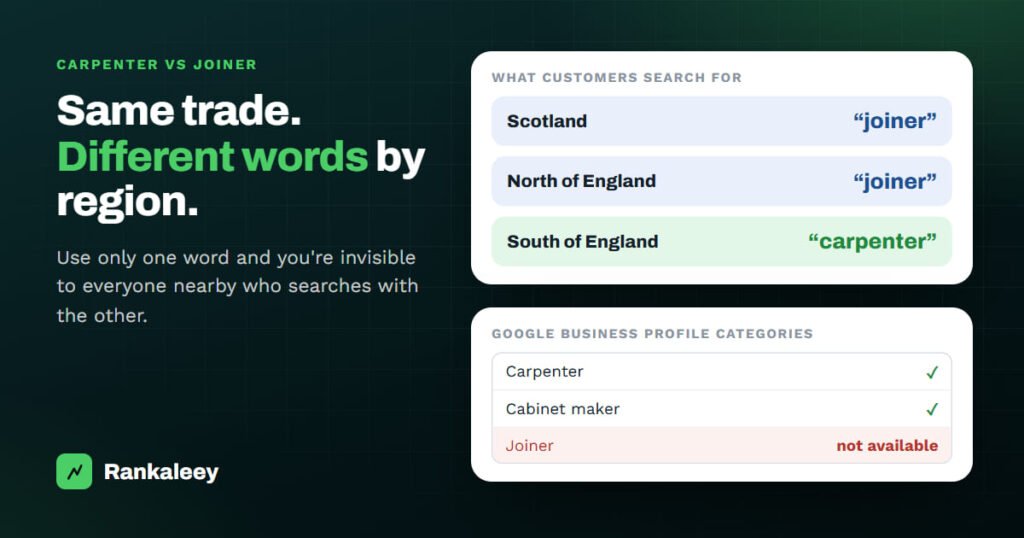
The short version: technically, a joiner makes wooden items in a workshop — bespoke furniture, staircases, doors, windows — and a carpenter fits and installs them on site. In practice, most UK tradespeople do both, and the two words are used interchangeably. For getting found online, the important thing isn’t the definition — it’s that your customers choose the word by where they live, not by the job they need doing.
The regional split
Across the UK the same trade goes by different names:
- South of England — “carpenter” is the default. Almost nobody searches “joiner near me” in Surrey.
- North of England — “joiner” is far more common, whether the work is in a workshop or on site.
- Scotland — “joiner” dominates, regardless of the type of work.
A joiner in Leeds and a carpenter in Reading can do identical work and still be found through completely different searches. If your website and Google Business Profile only ever use one of those words, you’re invisible to everyone nearby who uses the other one — and in the North and Scotland, that’s most people.
What each word implies — so you can use them where they fit
The terms carry slightly different associations, and you can lean on that rather than fight it:
- “Joiner” / “joinery” leans towards bespoke, made-to-measure, workshop work — fitted wardrobes, alcove units, staircases, sash windows, cabinetry.
- “Carpenter” / “carpentry” leans towards on-site fitting and structural work — hanging doors, laying floors, fitting kitchens, first and second fix, roofing timber.
Use whichever genuinely matches the page. A bespoke fitted-furniture page can lead with “joinery” even for a Southern business, because that’s the honest description of the work. A door-hanging or kitchen-fitting page can lead with “carpenter” even in Scotland. You’re not choosing a side once for the whole site — you’re matching the word to the job on each page.
Target both on one page, not two
Carpenter, joiner, carpentry and joinery are one keyword cluster. That means one strong page covering the trade — not a near-duplicate “joiner” version of your carpentry page. Two pages competing for the same thing split your authority between them, and a thin second page that just swaps the word looks like a doorway page to Google.
On that one page: put your main term — whichever suits your region — in the H1, the page title and the first paragraph. Let the other term appear naturally in a subheading, in the FAQs, in an image caption, and a few times in the body where it reads normally. What you’re avoiding is “carpenter joiner carpentry joiner” jammed into every sentence; a natural mix of both words across the page is exactly what you want.
Your Google Business Profile has no “Joiner” category
This catches a lot of joiners out. Google Business Profile offers “Carpenter”, “Cabinet maker” and “Furniture maker” as categories — but there is no “Joiner” category, and no “Woodworker” one either.
So even a Scottish joiner picks “Carpenter” as the primary category — or “Cabinet maker” if bespoke furniture is genuinely the core of the business — because that’s what exists to choose. Category is the single biggest on-profile ranking factor, so it has to be right regardless of what you’d call yourself.
The word “joiner” then has to be carried everywhere the category can’t: the business name, if it’s honestly part of your registered name; the profile description; the services list; your posts; and the replies you write to reviews. A handful of reviews that say “brilliant joiner, highly recommended” do real work for a Northern business, because Google reads the language customers use about you, not just the category box.
A practical checklist
- Pick your primary term by where you’re based — “carpenter” in the South, “joiner” in the North and Scotland.
- Use the other term where it honestly fits the work on a given page.
- One page for the trade, covering both words naturally — not two competing pages.
- Set your GBP primary category to “Carpenter” or “Cabinet maker”, and work “joiner / joinery” into the description and services where it reads naturally.
- Ask a couple of happy customers to mention the trade word in their review.
- After a few months, check Google Search Console to see which term your area actually searches for, and lean into it.
Getting found for both terms without tripping over Google’s spam filters is part of our local SEO for carpenters and joiners service, and the category and description work sits inside Google Business Profile optimisation.