How to Rank for “Fitted Wardrobes [Town]” and the Other Searches That Book Carpentry Work
Nobody searches “carpentry services near me”. They search “fitted wardrobes near me”, “media wall builder [town]”, “alcove units cost”, or “cost to hang internal doors”. Each of those is a different job with a different page behind it on the businesses that rank. A single “Services” page that lists everything you do once will rank for none of them, because Google can’t tell what the page is actually about.
The fix is a dedicated page for each job type you want more of. Building focused, single-topic pages is one of the highest-value, lowest-cost moves in local SEO — and for carpentry, where demand is split across a dozen very specific searches, it matters more than for most trades.
The job-type pages worth building, roughly in order
Start with the two or three that earn you the most, not the full list. In rough priority for a typical UK carpenter or joiner:
- Fitted wardrobes — the biggest single carpentry search there is, and it carries a real budget (£2,000–£5,000 for a standard bedroom, more for bespoke). It also has its own sub-searches to fold in: built-in wardrobes, sliding wardrobes, bespoke wardrobes, and “fitted wardrobe cost [town]”.
- Alcove units and alcove shelving — steady demand, especially around Victorian and Edwardian housing with chimney-breast recesses.
- Media walls — a fast-growing search in 2026, high homeowner intent, and still light on genuinely local pages.
- Staircases — new staircases and staircase renovation or restoration; part of a £16.7bn joinery installation market.
- Internal doors and door hanging — high search volume, smaller jobs, quick to book — a good page for keeping the diary topped up between bigger commissions.
- Understairs storage — specific, growing, and lightly contested.
- Kitchen fitting, garden rooms and offices, decking — build these only if you genuinely do them; garden rooms in particular have specialist competition.
Fold the tiny variants — sliding wardrobe doors, wardrobe carcasses, shelf runs — into their parent page rather than making thin standalone pages that dilute each other.
What each page actually needs
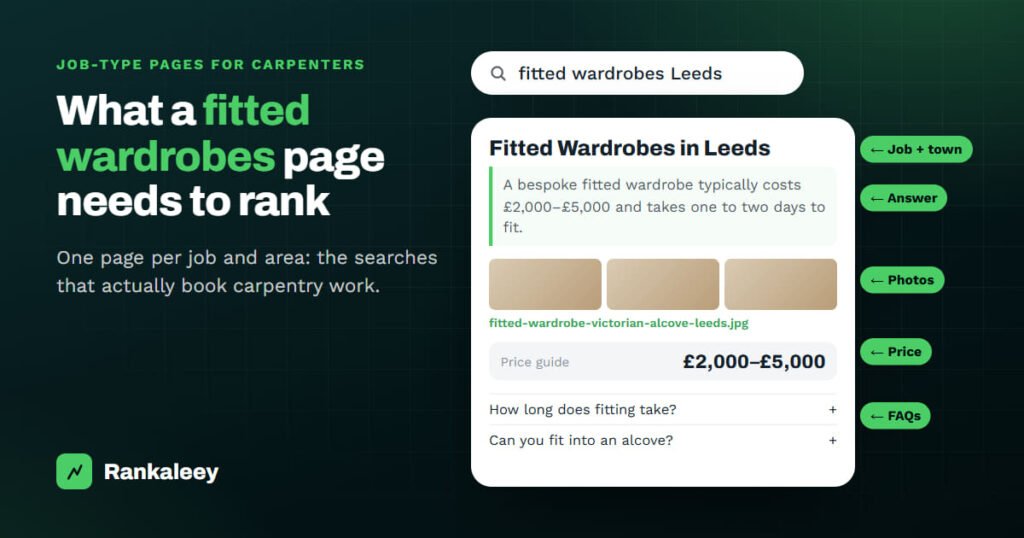
- An H1 that names the job and the area plainly — “Fitted Wardrobes in [Town]”, not “Our Services” or “Welcome”. This is the strongest single on-page signal for local relevance.
- A first paragraph that answers the question — what the job is, what it roughly costs, how long it takes, and that you do it in the area. The first 100 words of a page carry extra weight, so don’t open with a company history.
- Real photos of your own work — before-and-after pairs, several per page, not stock images. More on this below.
- A short, honest process — measure, design, build, fit, snag. Homeowners who’ve never commissioned bespoke work want to know what they’re signing up for.
- Price guidance — even “from £X per linear metre” or a typical range. Pages that give a number get chosen over pages that hide it.
- Three to five genuine FAQs — the questions you actually get asked on quotes, answered in a couple of sentences each.
- The practical bits — name, phone, response time, a click-to-call link and a short quote form.
- Area-specific detail — the property types you actually work on locally (period terraces with awkward alcoves, new-builds with sloped loft rooms), not a paragraph with the town name swapped in.
Photos are doing more work than you think
Google Images accounts for roughly a quarter of all searches on Google, and carpentry buyers scroll pictures before they read a word. A page with ten sharp before-and-after photos of real jobs will out-convert, and often out-rank, a wordier page with none.
Two things make those photos count for search as well as trust: descriptive file names (“fitted-wardrobe-victorian-alcove-bedroom-leeds.jpg”, not “IMG_4827.jpg” — the camera name tells Google nothing), and alt text that describes the actual job in about a sentence. Well-labelled images are also what AI tools pull when they show a visual answer to “what do fitted alcove units look like”.
How job-type pages and area pages fit together
Build the job-type page once — “Fitted Wardrobes” — and it ranks for the job. To reach specific towns beyond your immediate area, you then add town pages, or town-plus-job pages, that link back to it. That layered structure is exactly what our Service Area SEO Pages service builds.
Do it in that order. Starting with fifty thin town pages and no real service pages is the common mistake — you end up with a lot of pages and nothing that ranks. Build the strong service page first, then layer location on top. And link the job pages to each other while you’re at it (“we also build alcove units and understairs storage”) and up to your main carpentry page, so the whole set reinforces itself.
Getting these pages cited in AI search
A page that opens with a direct, factual answer — “A bespoke fitted wardrobe in [town] typically costs £2,000–£5,000 and takes one to two days to fit” — backs it with real FAQs, and keeps your business details consistent across the web is exactly what Google’s AI Overviews, ChatGPT and Perplexity quote when someone asks them “how much are fitted wardrobes” or “who fits alcove units near me”. You don’t need special markup for this. A clear heading, a real answer near the top, and consistent information do the job.
The order to do it in
- Pick your top three earners.
- Build a proper page for each — job-and-area H1, an answer in the first paragraph, your own photos, real FAQs, local detail.
- Link the pages to each other and up to your main carpentry page.
- Then layer town pages on top for the areas you want to reach further into.
- Keep the strongest page updated — new photos, refreshed prices — because the pages that hold their rankings are the ones that don’t go stale.
This is the structure behind our local SEO for carpenters service. If the pages are getting visits but the enquiries aren’t following, that’s usually a conversion problem rather than a ranking one — see Lead Conversion Optimisation.